.avif)
Did you know that the traffic induced by a project can be just as significant as the emissions from the activity itself?
Transport impact assessment is an essential and increasingly required component of Environmental Impact Assessments (EIA). Projects involving infrastructure, logistics parks, renewable energy, or new urban developments generate traffic flows that significantly alter the physical and social environment. These changes affect not only the environment (emissions, noise, land fragmentation, etc.) but also the local socioeconomic balance (accessibility, road safety, mobility, etc.).
In this context, a rigorous transport impact assessment becomes a key element for the administrative and social acceptance of projects. At our firm, we specialize in integrating this type of analysis into broader environmental and socioeconomic studies, complying with current regulatory requirements in Spain and applying proven technical and scientific methodologies.
Applicable legislation and technical requirements
The primary regulatory basis is Law 21/2013 on Environmental Assessment, which requires the inclusion of a comprehensive analysis of the impacts derived from the project, both during its construction and operational phases. Within the technical annexes of the EIA, induced traffic, associated emissions, and impacts on the population's quality of life must be considered.
In addition, there are other relevant sectoral regulations:
- Law 37/2003 on Noise and its development in RD 1513/2005 require the assessment of increased noise pollution derived from traffic, especially in sensitive areas.
- The CNOSSOS-EU regulation, adopted in Spain, establishes the framework for noise modeling in projects with significant traffic.
- In broader socioeconomic impact studies, effects such as road safety, connectivity of rural centers, and pressure on local infrastructure must also be considered.
Compliance with these regulatory frameworks requires the use of specific tools (such as traffic models, noise maps, or emission simulations), in addition to well-justified qualitative and quantitative assessment criteria.
Why is transport analysis important in an EIA?
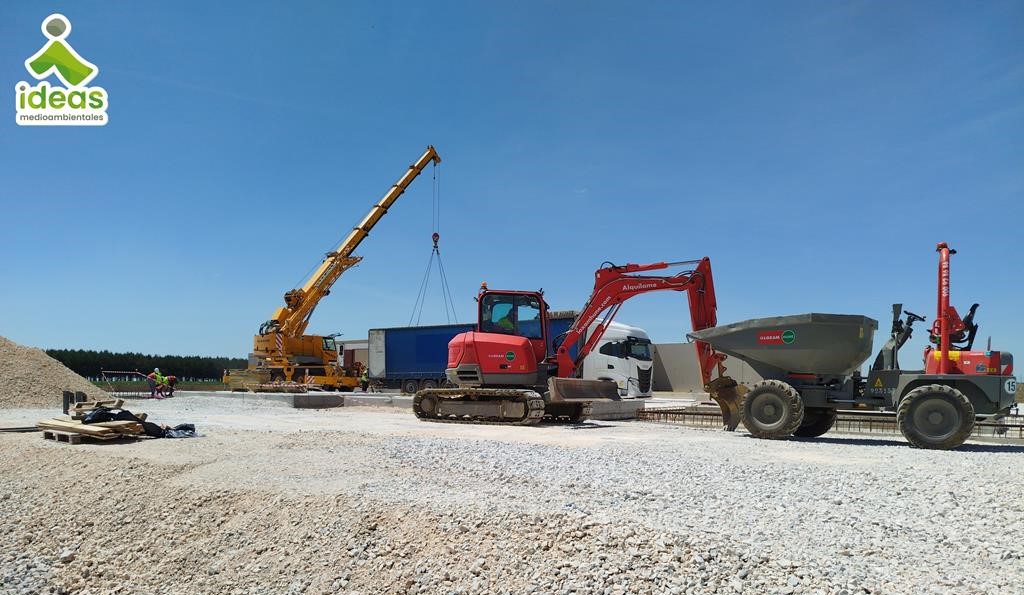
Transport associated with a project, especially during the construction and operation phases, generates a series of environmental and social impacts that must be rigorously assessed within the Environmental Impact Assessment (EIA); its omission or undervaluation can lead to objections during processing, public complaints, or unforeseen environmental conditions. Thus, variations in transport affect multiple environmental and social variables.
Environmental impacts:
- Noise and vibrations on nearby rural or urban roads.
- Atmospheric emissions (NOx, PM₁₀, CO₂) from road traffic, especially if heavy machinery or intensive transport is involved.
- Soil or water contamination from accidental spills or wheel washing.
- Increased risk of wildlife collisions.
- Territory and landscape fragmentation
Social impacts:
- Increased local traffic, affecting resident mobility.
- Deterioration of existing road surfaces or infrastructure on agricultural paths or forest tracks.
- Neighborhood conflicts due to recurring disturbances (noise, dust, road safety concerns).
- Increased risk of accidents, especially in school zones, urban areas, or at intersections.
It is essential for both the administrative and social approval of projects, as well as for their proper development, that these impacts are taken into account and that mitigation and compensatory measures are applied.
What can a specialized company like Ideas Medioambientales contribute?
A company expert in environmental and socioeconomic impact studies must offer much more than just the drafting of a technical annex. Our approach is based on:
1. Comprehensive diagnosis of generated traffic
We analyze the traffic flows generated by the project in all its phases, estimating volume, vehicle type, schedules, and frequency. We use traffic models and official statistical sources to ensure a robust estimate. We focus on the study of access points and mobility.
2. Integrated assessment of environmental and social impact
We apply various tools to correctly assess the implications of the impact caused by transport. GIS (Geographic Information Systems) are essential for designing layouts, mapping routes, and conducting territorial sensitivity analyses. We also rely on atmospheric emission models recommended by MITECO (emissions guide) or the EEA (European Environment Agency and its EMEP/EEA guide) to perform calculations rigorously. Finally, we implement acoustic modeling using CNOSSOS-EU, which has been mandatory in Spain since 2021 for assessing traffic noise.
3. Corrective measures and viable alternatives
We design proposals to minimize the negative effects of transport: alternative routes, access planning, time restrictions, sustainable mobility solutions, or communication strategies with the affected population.
4. Adaptation to the requirements of each autonomous community
Each administration has its own technical and methodological criteria. Our team has direct experience in EIA for different regions (Andalusia, Castile and León, Valencia, Catalonia, etc.), which guarantees deliverables that strictly comply with specific specifications and legal requirements.

Don't let any details slip through the cracks when preparing your project
Including a rigorous transport analysis in an environmental or socioeconomic impact study is not just a legal requirement: it is a key tool for anticipating conflicts, designing sustainable projects, and achieving greater social acceptance.
If your project needs to meet current environmental and social requirements, we can help you incorporate transport analysis in an integrated, technical, and effective way, with the assurance that every step of the process will be aligned with current regulations and a strategic vision of the territory.
At Ideas Medioambientales, we provide experience, technical expertise, and local knowledge. We offer a detailed diagnosis for a realistic traffic estimate by phase, evaluate noise, emissions, and mobility impacts, propose viable and affordable corrective measures, and have extensive experience with the requirements applied by different autonomous regions.

.avif)
.jpeg)