.avif)


Discover the history, Paleolithic cave paintings, and archaeological wealth of El Niño cave in Aýna, Albacete. This key site, which bridges the gap between Levantine and Cantabrian art, is accessible only by guided tour.
We continue our discussion of areas with great archaeological value that we include in our section on Archaeological Assessment and Control; in this case, we present La Cueva del Niño, located in the municipality of Ayna, in the southwest of the province of Albacete.
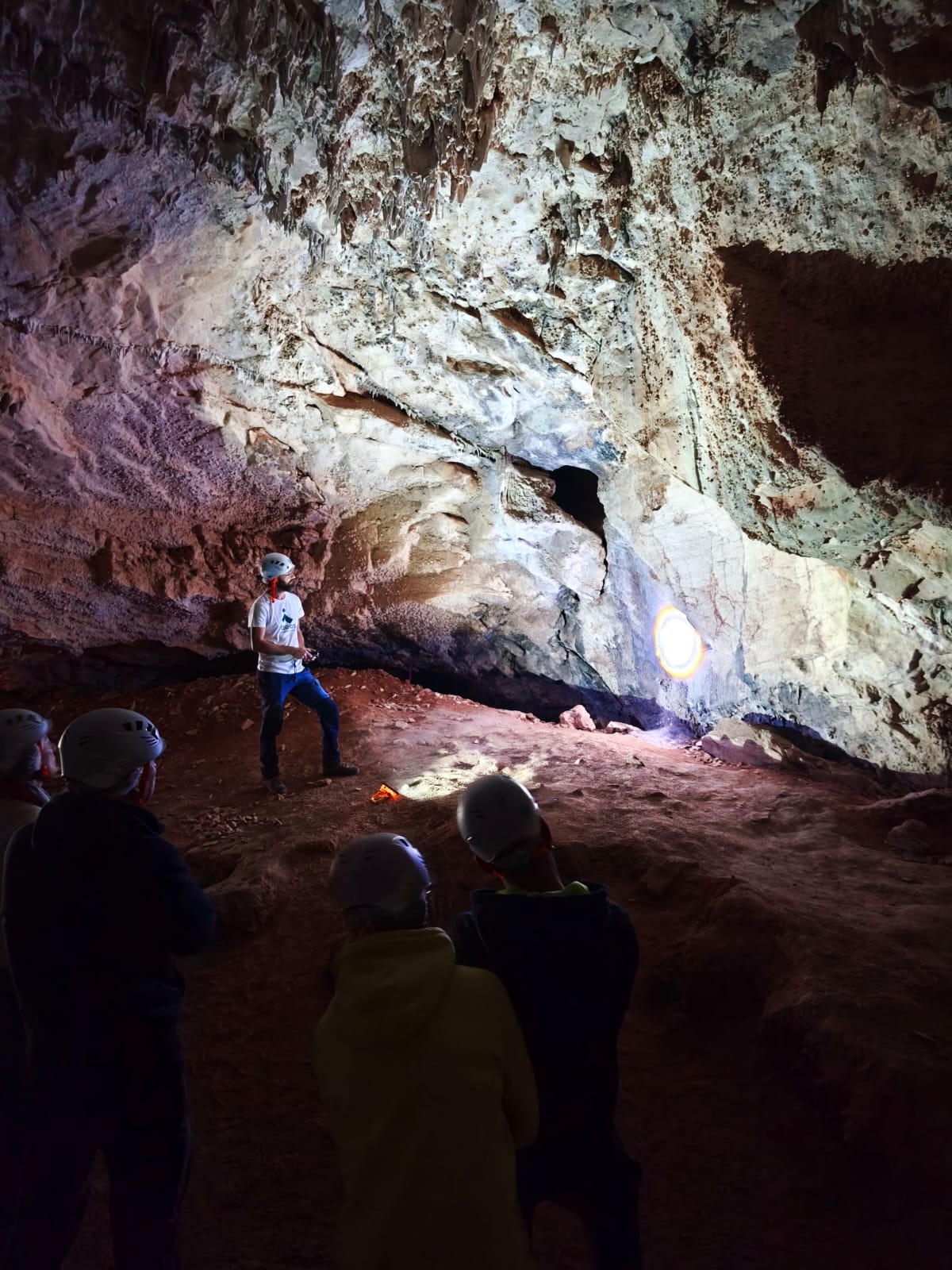
The cave is situated at an altitude of approximately 700 meters above sea level, in the eastern foothills of the Sierra de Alcaraz, in the upper reaches of the Mundo River. This tributary of the Segura River collects water from the entire southern slope of the mountain range, where a multitude of ravines converge. The cave is located halfway up one of these, the Barranco del Infierno. It has an irregular, roughly oval floor plan with the entrance at one end, and is divided into two main chambers separated by a thick stalactitic column.
The discovery of the cave
Although the cave had long been known in the region, its cave paintings were not discovered until May 1, 1970, as recounted by M. Almagro (1971, 1972). The discovery was entirely accidental, made by young hikers exploring the cave with flashlights. Upon returning from their excursion, they reported the find to the mayor of Peñas de San Pedro, who notified the then-director of the Museum of Albacete and Provincial Councillor of Fine Arts, Samuel de los Santos Gallego. He visited the cave on May 9 of that year. Given the undeniable importance of the discovery and the risk of uncontrolled visits and damage, the general commissioner of excavations decided to send Martín Almagro Gorbea to conduct an accurate assessment of the site and ensure its proper protection. The cave was subsequently enclosed with an iron fence to prevent unauthorized access while preserving the interior climate necessary for the paintings. During successive visits, researchers discovered remains of lithic industry and printed ceramics, confirming the site's archaeological significance, in addition to other paintings found outside the cave belonging to the Levantine Art cycle.
The excavations at the site
In 1973, the sedimentary fill of the deposit was subjected to a series of stratigraphic surveys led by Dr. Iain Davidson. The primary objective was to gather information regarding the economic models and chronology of the various occupations that occurred at the site during the Upper Paleolithic (Higgs et al. 1976). Excavations focused on four small test pits: two inside the cave, where the greatest stratigraphic development was found, and two outside, near the rock art panels. Dating the site proved challenging due to the lack of radiocarbon chronology or clear typological or faunal evidence. According to Davidson (1980), the site may have had three main phases of occupation. The first, documented in external surveys, dates to the Middle Paleolithic. During this time, subsistence was based on hunting a variety of mammals, mainly goats and horses, though remains of deer, roe deer, rabbits, aurochs, and even rhinoceros were also found. These occupations likely consisted of short-term seasonal visits. Remains of carnivores, such as lynx and bear, were also recovered from these lower strata, though it remains unclear whether they were prey to Neanderthals or if they occupied the cave after humans had abandoned it.
The middle phase, perhaps related to the final periods of the Upper Paleolithic and documented in the open survey in front of the main panel, revealed a series of structural levels with evidence of hearths, ditches, and post holes—elements that were poorly documented due to the lack of extensive excavation at the site. Here, in the so-called Inner Trench survey, remains were dated to approximately 27,000 years ago based on Carbon-14 analysis of a bone fragment.
Finally, the upper deposits contain an Epipaleolithic industry, which is overlaid by two periods of intensive occupation during the ceramic era. Dr. Chapman distinguished two episodes based on the small sample of recovered ceramic material: one corresponding to the Neolithic period and the other to a later chronology.
Paleolithic pictorial representations
The study of the paintings—both the Paleolithic ones inside and the Levantine-style ones outside—was conducted by Dr. Martín Almagro Gorbea (1971, 1972), who identified two panels with Paleolithic representations: the most important one in the entrance chamber, and a second on one side of the interior chamber. In total, there are twenty-two figures represented by Paleolithic humans in the Cueva del Niño. Thirteen are animal representations, and the rest consist of abstract or complementary figures. It is important to note that all these representations are monochrome and painted (no engravings have been found to date). They offer a range of red tones, with variations in intensity attributed by the aforementioned author to the use of different types of pigments, which may have relative chronological value, indicating different moments in the creation of the paintings.
In the main chamber, the cave representations are concentrated on a single panel—a wall canvas located to the left of the entrance in a twilight zone, allowing the figures to be seen in natural light. This vestibule panel consists of 13 markings: 3 correspond to two lines and a dye stain, while the remaining 10 are animal figures, though one cannot be definitively identified. Among the identified figures are:
- A goat oriented horizontally to the left, facing the outside of the cave. This figure is highly detailed, featuring a cut on the belly (a line parallel to the belly that could indicate a change in the animal's coat color) and two vertical lines on its body, which could represent projectiles. It is located on a lower canvas, at a different level from the rest of the panel, and is currently covered by a layer of calcite, though it remains perfectly visible.
- Two facing ibexes, one facing right (towards the inside of the cavity) and slightly tilted downwards, and the other facing left.
In the center of the panel, we find three deer figures: two large males and one female. The latter is located below the larger deer, and only the front half of the animal (the head and front half of the body) is represented. It displays typical conventions for this type of animal in Paleolithic rock art, such as the elongated nose and V-shaped ears. The two deer are undoubtedly the main figures of the panel, both due to their central position and their size, as they are the largest figures present. Both are rendered with great detail, featuring antlers, ears, eyes, and internal lines.
Below the deer, we find two figures, both arranged horizontally and facing right. One is a horse—the only one in the cave—and the other is a goat, very similar to the one at the opposite end of the panel, as it also features a colored fill, an interior cut line, and a possible projectile.
This panel is completed by a vaulted figure, impossible to identify due to its poor state of preservation. It is located on a separate canvas, perpendicular to the rest of the panel and inclined towards the floor. It shows a horn facing forward or the beginning of another, and while it could correspond to an aurochs (a prehistoric bull), it is impossible to confirm.
Separated from the vestibule by a jumble of blocks and a large stalagmitic formation is the second sector containing rock paintings, divided into three zones: a passage area formed by the fallen blocks that separate the inner area of the cavity from the vestibule, where a stain is located; a second area on the left side of the cave, which contains the main panel of the interior sector; and finally, a third panel located at the back of the cavity, which contains an indeterminate animal figure.
Finally, we must point out the existence of three stylized anthropomorphic figures at the entrance of the cave. These belong to the Levantine art style and are therefore chronologically far removed from the paintings found inside; no relationship between the two styles can be inferred simply from their presence at the same site.
Interpretation and meaning of the paintings
The great importance of the Paleolithic paintings in the Cueva del Niño (Almagro 1972) lies, beyond their artistic quality, in their geographical location. They occupy a void in the distribution of rock art from this period, connecting the Paleolithic artistic areas of the peninsular Levant (Parpalló, Cova Fosca) with the abundant sites in Malaga (La Pileta, Doña Trinidad, Nerja, Higuerón, Toro). Likewise, the discovery of this type of representation in various areas of the plateaus (Cueva de La Griega in Segovia, Los Casares in Guadalajara) has challenged the traditional concept of a "Mediterranean artistic province," as these sites combine characteristics typical of Cantabrian art with the stylization and schematization of the Mediterranean (Villaverde 1988).
Regarding the chronology of these paintings, Almagro (1973) points out their great stylistic unity. Although he separates them into four different production phases, he believes they could be placed in the Aurignacian-Perigordian cycle according to the chronology established by H. Breuil (1952). However, according to the system of styles coined by Leroi-Gourhan (1965), the representations in the Cueva del Niño could correspond to his Style III, with a chronology dating to the end of the Solutrean or the beginning of the Magdalenian.
For J. Fortea (1978), a distinction could be made between the deer and horses, on the one hand, which would date to the Middle and Upper Solutrean (20,000–17,000 years ago), and the large deer and goats on the main panel, whose incised lines on the neck and belly, respectively, are typical conventions for representing coat color differences characteristic of Leroi-Gourhan’s early Style IV (Barandiarán 1972). To these more recent representations, we should add the serpentiform figure with an internal stripe, which finds its closest parallels in the engraved plaques of the Magdalenian III of Parpalló, dated to 13,800 B.P. For the time being, it is very difficult to resolve this dilemma because we lack sufficient knowledge of the development of the Upper Paleolithic in this region or in the cave itself, where the excavations carried out by I. Davidson and H. Higgs in 1973 did not yield the desired results, as previously mentioned.
Following their discovery and subsequent excavation, the cave paintings in the Cueva del Niño were reviewed several times, notably in 1978 by Javier Fortea and in 1994 and 2003 by Javier Alcolea and Rodrigo de Balbín. These works focused primarily on the possible chronology of the representations and their parallels with other Cantabrian, Levantine, or Meseta sites. Along with the review of the paintings, several works were also published on the archaeological site and the surface sites documented during the survey campaign, highlighting the work of José Luis Serna on the Middle Paleolithic of the region.
Visit the cave
As reported by the Ayna City Council, a visit to the Cueva del Niño must be made with a guide. The site is located 16 kilometers away by road, followed by 2 kilometers of forest track and a 45-minute walk on a mountain path from Ayna. It is necessary to bring water, a flashlight, and appropriate footwear.
Tour reservations must be made several days in advance. For more information:
Tourism Office: 967 29 53 16 or City Hall: 967 29 50 01
Bibliography
- ALMAGRO GORBEA, M. (1971). “La Cueva del Niño (Albacete) and La Cueva de la Griega (Segovia). Two rock art sites recently discovered in the Iberian Peninsula.” Trabajos de Prehistoria, 28, 9-62.
- — (1972). “Discovery of a cave with Paleolithic rock art in the province of Albacete.” In Santander International Rock Art Symposium, 475-497. Santander.
- BALBÍN BEHRMANN, R. and ALCOLEA GONZÁLEZ, J. (1994). “Paleolithic art of the Spanish Plateau.” Complutum, 5, 97-138.
- DAVIDSON, I. (1989). The economy of the end of the Paleolithic period in eastern Spain. Valencia: Prehistoric Research Service of the Provincial Council of Valencia. 85.
- DAVIDSON, I. and GARCÍA MORENO, A. (2013): The 1973 archaeological excavation of the Cueva del Niño (Ayna, Albacete): stratigraphic sequence and materials. Al-Basit 58, pp. 91-117.
- FORTEA, J., (1978). Paleolithic Art of the Spanish Mediterranean, Trabajos de Prehistoria, 35.
- MARTÍ OLIVER, B. (1988). “Neolithic vase from the Cueva del Niño (Ayna, Albacete).” In Homage to Samuel de los Santos, 77-80. Albacete: Institute for Albacete Studies “Don Juan Manuel.”
- SERNA LÓPEZ, J.L. (1997). “Considerations on the economy and occupation of the territory during early prehistory. The case of the Paleolithic and Epipaleolithic sites in the Mundo River basin.” Archivo de Prehistoria Levantina, 22, 57-71.
- — (1999). The Middle Paleolithic in the province of Albacete. Albacete: Institute for Albacete Studies “Don Juan Manuel.”
VILLAVERDE, V. (1988). “Considerations about the Parpalló sequence and the Paleolithic art of the Spanish Mediterranean” Levantine Prehistory Archive 18, 1988, pp. 11-47 - ALEJANDRO GARCIA-MORENO “https://cuevadelnino.wordpress.com”
.avif)
.jpeg)