.avif)


Interpretation of evidence from faunal remains in the field
As part of the professional training encouraged by Ideas Medioambientales, a course was held focusing on the information that can be gathered from observing animal remains in the natural environment. The course was taught by Ángel Tórtola.
Some might ask: Why do environmental professionals look for animal carcasses and remains?
Locating and analyzing wildlife remains provides key information about species mortality, causes of death, the presence of threats in the area (such as infrastructure, collisions, electrocutions, or potential poisoning), as well as the health status of wildlife. These findings help to detect environmental problems, assess the impact of human activities, prevent health risks, and propose more effective conservation and management measures .
.png)
To better understand all of this, it is necessary to briefly discuss “decomposition” …and yes, even the word sounds harsh to us, let alone the work of searching through animal remains. To many people, this surely seems like a grotesque, smelly, tedious, and messy job; and honestly, they wouldn't be far from the truth. Some remains are in such poor condition, with pieces scattered over several meters, that trying to identify the animal becomes a puzzle. It requires a great deal of cleaning and biosecurity when handling the pieces, as they could transmit diseases to the handler.
In this puzzle, each piece may have a strong smell of decay, accompanied by a community of microorganisms (MOOs) such as fungi and bacteria, which, although it may not seem like it, are doing important work for the proper functioning of our ecosystems.
When we see a dead hare or cat on the road, we most likely assume that it will disappear due to the action of scavengers like foxes or birds of prey like vultures, but beyond the large animals we can see with the naked eye, there is an entire community of organisms.
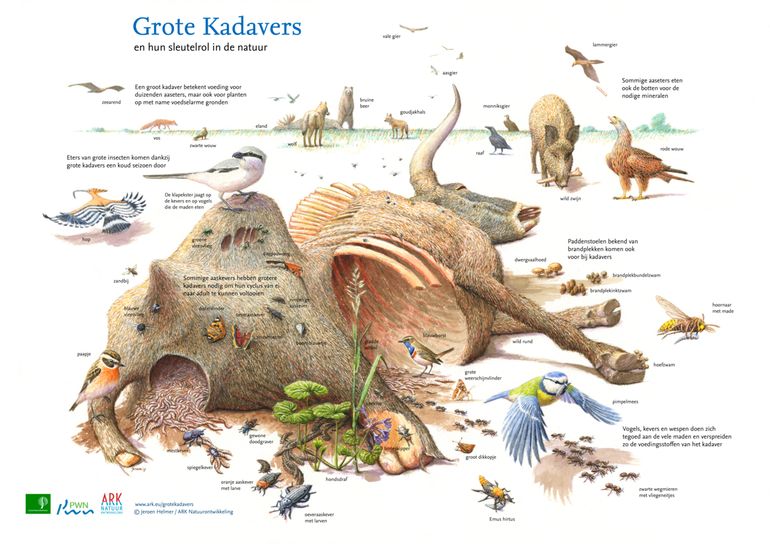
The decomposition of a carcass is a highly complex ecological process, involving numerous organisms, both necrophagous invertebrates and vertebrates that act sequentially and complementarily. Thanks to this interaction, a large mass of organic matter, such as an ox carcass, is progressively transformed into nutrients available to the soil, closing biogeochemical cycles and contributing to the fertility and functioning of ecosystems.
Returning to the "why," carcasses are sought after, among other things, to assess mortality in wind and solar farms, and based on the findings, to propose solutions to prevent these events. Searching for carcasses also allows for the control and detection of zoonoses (identifying potential public health risks) and epizootics (detecting as early as possible diseases transmissible between wildlife and livestock).
This, in turn, allows for the activation of epidemiological surveillance protocols before the problem spreads. From an ecological perspective, it allows for predation studies, species presence, and monitoring, among others.
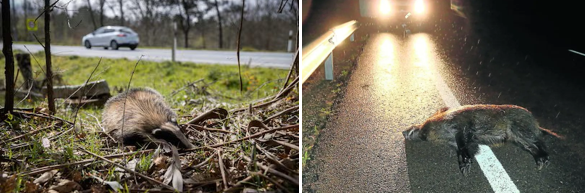
There are also certain times with a higher frequency of mortality, such as specific seasons, etc. As well as periods of migratory passage and in summer, when many individuals of different species, such as the common swift (Apus apus) fall from their nests due to heatstroke.
At Ideas medioambientales, we have a complete and innovative team specialized in carcass searching, including a canine unit. We invite you to read the Biocan Utility 2.0, Ideas Medioambientales' commitment to highly efficient solutions.
WHAT DATA CAN WE OBTAIN FROM A CARCASS?
- Approximate date of death
- Cause of death
- Location of death
- Species. In certain cases, in addition to the species, it is possible to determine the specimen's age, sex, physical condition, etc.
To estimate an animal's date of death, it is very important to observe the stage of the decomposition process it is in; there are guides and decomposition phases for this. In birds of prey, you can tell if a carcass has been dead for one or several days just by looking at the eye; below is an estimate of the hours (for guidance purposes):
- 0–12 hours: Bright and moist eye. Firm eyeball.
- 12–24 hours: The loss of moisturebegins. Slight corneal clouding. The eyeball still maintains turgidity.
- 24–48 hours: Gradual sinking of the eyeball (enophthalmos), depending on environmental conditions (temperature, relative humidity, etc.). Opaque cornea. Dryness
- >48–72 hours: Severely collapsed or absent eye
(De León et al., 2022; Valverde et al., 2020)
STAGES OF DECOMPOSITION
- Fresh carcass, dehydration of mucous membranes (eyes, mouth, genitals), the body becomes flaccid. Arthropods such as ticks and fleas leave the body. Rigor mortis (body stiffening) begins between 2-6 hours after death; however, depending on environmental conditions, this process can take up to 36-48 hours.
- The carcass begins to bloat due to gases such as methane, carbon dioxide, and ammonia, among others; once released, these produce the strong smell of death that many of us recognize. In this phase, necrophagous insects such as flies from the family Calliphoridae or Sarcophagidae arrive to feed and lay eggs, where their larvae decompose tissues.
- Carcass in active putrefaction.
- Carcass is desiccated, but skin still covers the bones. In this phase, beetles from the family Dermestidaepredominate.
- Carcass is completely reduced to bones; tendons and cartilage disappear, and in the case of birds, feathers gradually vanish.
FUN FACTS
Something that was shocking for everyone to see was the "sardonic grin" (Figure 4), or poisoning grimace in mammals. It is a characteristic symptom of death by poisoning, resulting from the spasmodic contraction of facial muscles, often associated with poisons that affect the nervous system. This grimace is frequently observed in wild animals such as bears, wolves, or birds of prey after the ingestion of toxic substances.
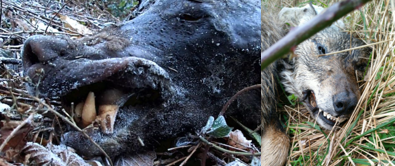
We know these images are unpleasant to see and may cause sadness, anger, or frustration due to the poor animals that are victims of direct or indirect poisoning caused by humans, but it is still important to show them, as these are clear indicators of the cause of death and allow for a quick understanding of what caused the animal's passing.
IDENTIFICATION THROUGH BONE REMAINS
On the other hand, during the practical session, Ángel Tórtola showed us a large collection of remains from various animals that he uses for environmental education purposes. We were able to observe all kinds of remains from multiple mammal species such as fox, dog, domestic cat, beech marten, badger, and common genet.
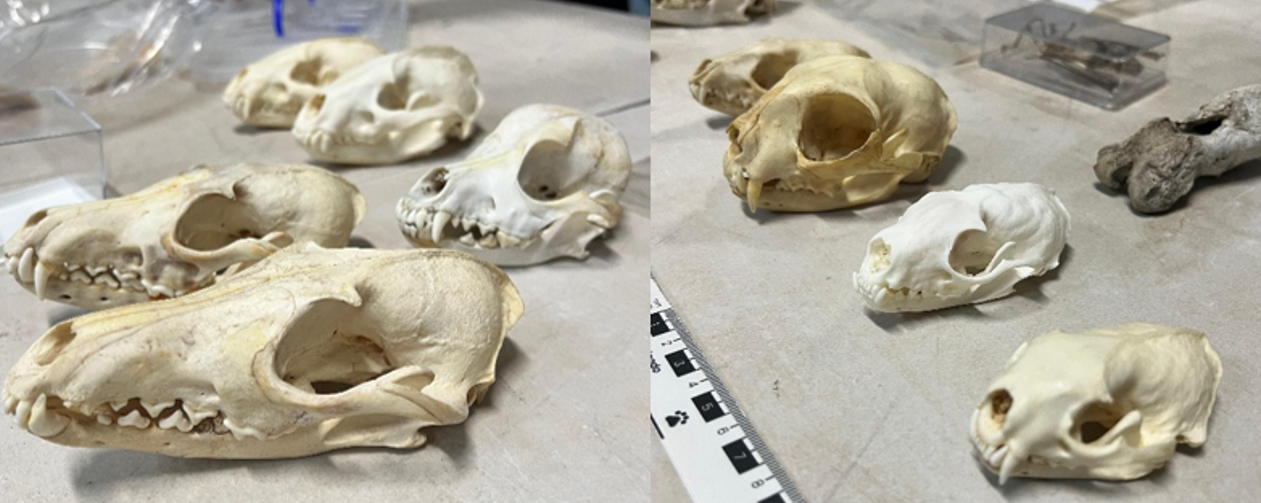
Something very curious about the skulls of the European badger(Meles meles) is the ridge that protrudes from the top of the skull, something not seen in the rest of the specimens shown. The “sagittal crest” is a bony protrusion located along the midline (sagittal suture) that acts as an attachment point for the temporal muscles, indicating an animal with an exceptionally strong jaw. It is common in species with a high bite force, such as gorillas, lions, other mustelids, as well as some hominids like Paranthropus aethiopicus.
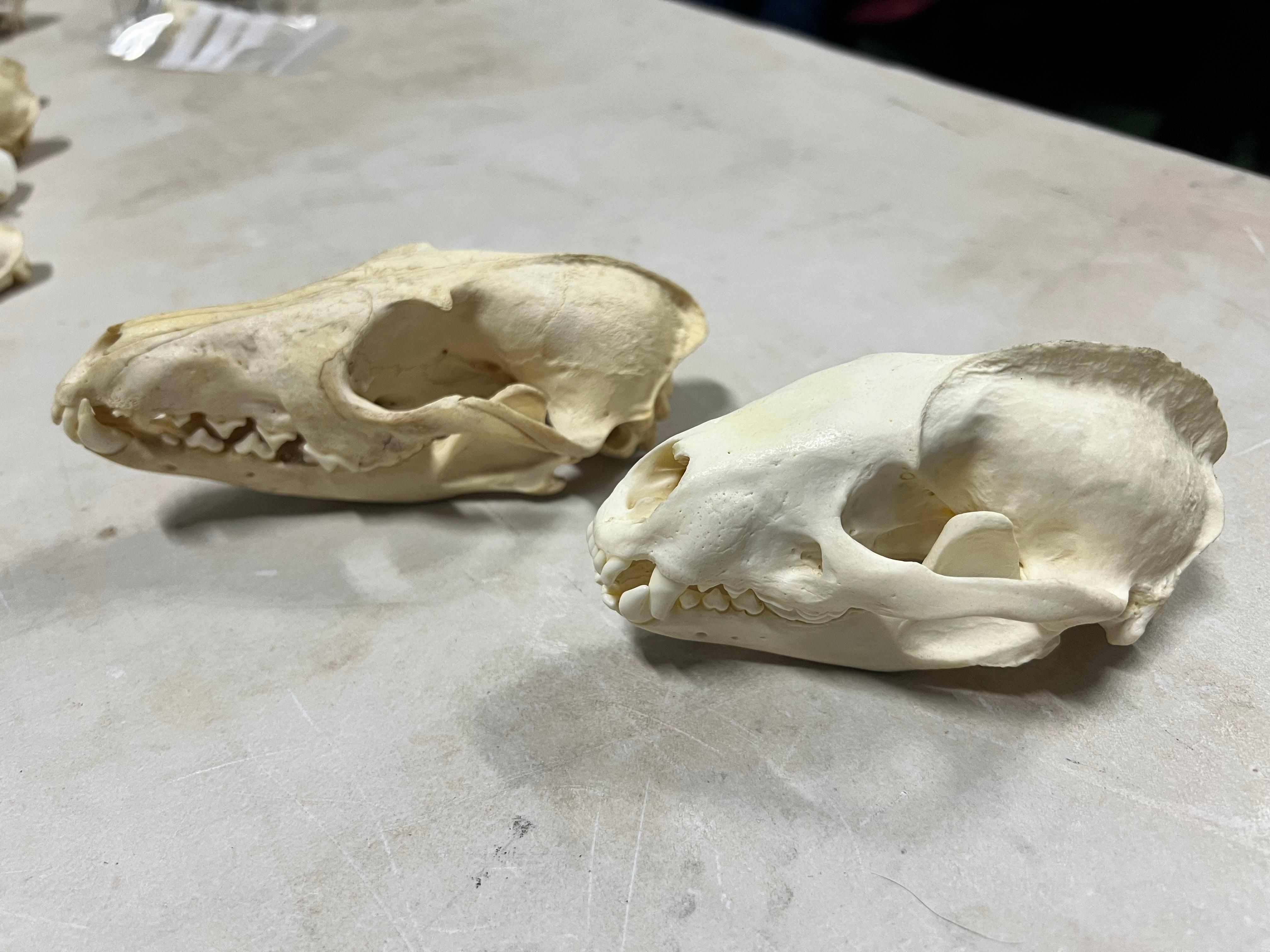
The figure above clearly shows the significant difference between the skull of a canid, such as a fox, and a mustelid, such as a badger. The badger's sagittal crest is notably massive and pronounced, reaching up to 16 mm in height in adults. It is essential for the badger's burrowing lifestyle and omnivorous diet, which requires breaking through roots and tough structures; it is a key morphological adaptation for the species' survival, facilitating both the excavation of their setts and the acquisition of food. It is not developed in young individuals, being a characteristic feature of mature adults. Thus, by knowing the size of the skull, the animal's dentition, and observing the large sagittal crest, the species can be identified.
Equally surprising are the skulls of birds, such as those of the griffon vulture (Gyps fulvus) and the Eurasian eagle-owl (Bubo bubo), due to their size and curious structures. In the case of the Eurasian eagle-owl skull (Figure 7), it can be observed that the beak still retains the “rhamphotheca”, the name given to the hard tissues that form a bird's beak. It is composed of keratin (the same substance as our fingernails) and the underlying bone that provides support. This allows for easier cutting, tearing, and piercing, while covering and protecting the beak bone.
.jpeg)
On the other hand, it can also be observed that in the eye sockets of the Eurasian eagle-owl skull are the “sclerotic rings”, small bony pieces that assemble to form a ring around the front part of the eye in many birds (and some reptiles and fish). They are not visible to the naked eye as they are covered by tissue and feathers, but they surround the cornea internally.
The eyes of many birds (especially nocturnal raptors) must be very rigid and perfectly aligned for sharp focus. In the case of owl eyes, they are elongated and tube-shaped, which gives them extraordinarily sharp vision, essential for hunting in low light. But that rigidity also means they cannot move their eyes within their sockets like we humans can. To compensate, many owl species have the ability to rotate their heads up to 270° when searching for or locking onto prey.
CONCLUSION
In forensic veterinary medicine, zooarchaeology, taphonomy, and carnivore studies, bone structures such as the sagittal crestor the sclerotic rings can exhibit significant interspecific variability. This is how small bone structures can serve as a great guide for identifying highly characteristic traits of a specific species.
Ultimately, cadavers, with few words or even none at all, provide us with a wealth of clues. The structure, wear, shape, size or color of the remains allow us to infer more and more information about the species, the individual's age and, in many cases, the possible cause of death.
So today we leave you with this final thought: corpses don't talk… but they certainly don't keep anything quiet.
Disclaimer
This content is in no way an invitation for the general public to search for or handle animal remains. It is for informational purposes only, with the goal of explaining the importance of locating and analyzing these remains within a professional context. If you find a carcass, do not touch it and call 112 to report it, especially in the case of large animals or those that could pose a health risk.
Carcass remains provide valuable insights into causes of mortality, help detect environmental threats, allow for the assessment of wildlife health, and reveal the methodologies used for species identification. This is, therefore, an informative look at the technical and scientific work carried out by qualified professionals in the natural environment.
BIBLIOGRAPHY
De León, A., et al. (2022). Decomposition stages as a clue for estimating the post-mortem interval in carcasses and providing accurate bird collision rates. Journal of Avian Biology 12, 16188.
Valverde, I., Espín, S., María-Mojica, P.et al. (2020). Protocol to classify the stages of carcass decomposition and estimate the time of death in small-size raptors. Eur J Wildl Res 66, 93. https://doi.org/10.1007/s10344-020-01429-3
.avif)
.jpeg)