.avif)


CONEIA 2026 Workshop: practical case studies for addressing cumulative and synergistic impacts in environmental assessment.
As part of the XIII CONEIA 2026, on Thursday, May 7th, we will host a Thematic Block Workshop on “Methodological Advances in Environmental Assessment” titled Potential Impacts Workshop: From Cumulative Effects to Synergy. This will be a workspace dedicated to sharing real-world experiences and technical approaches applicable to professional environmental assessment practice.
The workshop is structured around four case studies, selected for their ability to illustrate common methodological challenges in complex projects, particularly regarding the identification and assessment of potential impacts, including cumulative, synergistic, and contextual effects. This repository aims to facilitate methodological transfer, beyond the congress itself, and serve as a reference for technicians, consultants, and public administrations.
The approach taken in all cases prioritizes the technical reasoning process over final results, focusing on how to define scenarios, identify concurrent pressures, and justify the relevance of the environmental factors analyzed.
Case studies
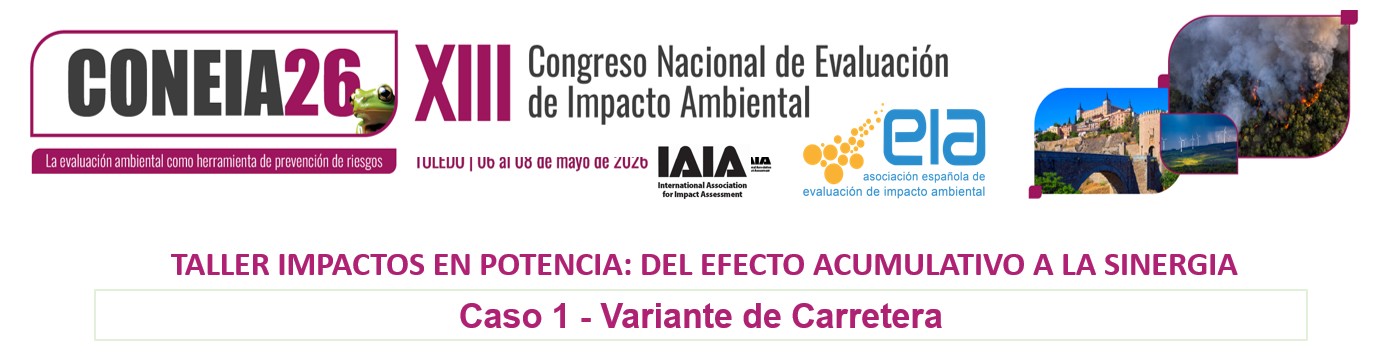
- Case 1, a peri-urban road bypass, focuses on terrestrial wildlife connectivity, addressing the accumulation of linear infrastructure, fencing, and night lighting on functional corridors already constrained by the territorial context. The methodological interest lies in the functional analysis of the agroforestry mosaic and the identification of critical points where small design decisions can have disproportionate effects on connectivity.
Access information for this case by clicking on this image and to the map at this link
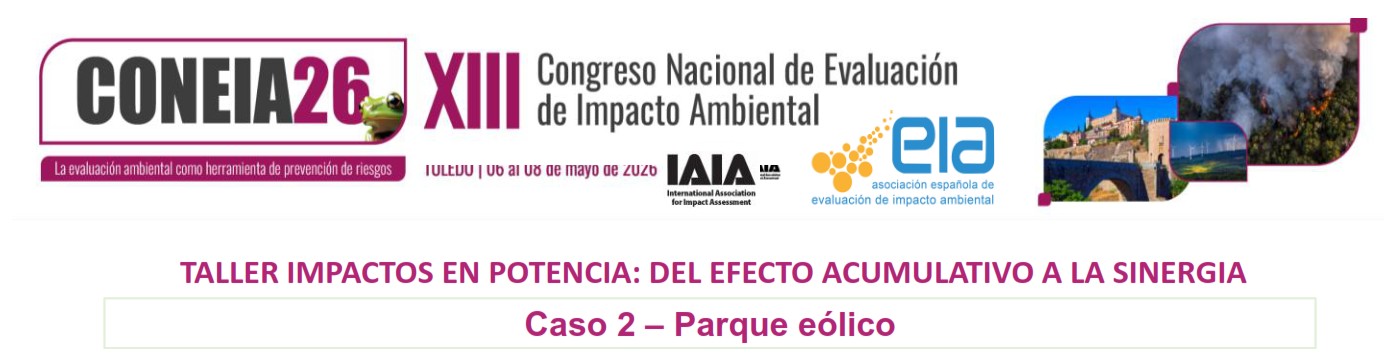
- Case 2, a wind farm in a mountain range with high scenic value, analyzes the cumulative and synergistic effects on landscape visibility associated with the coexistence of different generations of wind turbines, electrical infrastructure, and new energy developments currently in the permitting process. The case focuses on defining horizon scenarios and interpreting the landscape as a dynamic visual system, rather than analyzing each project in isolation.
Access the information for this case by clicking on this image and the map at this link
- Case 3, land clearing for hillside cultivation, addresses soil loss due to erosion from a watershed perspective, incorporating simultaneous pressures such as agricultural intensification, the removal of traditional soil conservation features, and the lingering effects of recent wildfires. The case illustrates the importance of considering irreversible processes and long-term dynamics in environmental assessment, especially in the context of climate change.
Access the information for this case by clicking on this image (no map)
- Case 4, a biomethane plant in an agricultural and livestock setting, deliberately introduces a different approach by analyzing positive synergies in the management and recovery of organic waste at a regional scale. The analysis focuses on how centralized, technologically advanced management can transform an existing environmental problem—pressure from slurry and agro-industrial byproducts—into an opportunity for environmental improvement, nutrient cycle closure, and emission reduction, provided that planning, traceability, and control mechanisms are properly articulated.
Access the information for this case by clicking on this image (no map)
Sharing results
To facilitate the exchange and comparison of conclusions among participants, the workshop results can be recorded on the shared participation sheet, available at this link or preferably, results can be submitted via this online form, designed for convenience and to facilitate the structured sharing of final conclusions.
.png)
Common methodological approach
All four cases followed a consistent structure based on:
- Clear definition of the key environmental factor.
- Reasoned identification of existing and foreseeable concurrent pressures.
- Scenario analysis with and without the project.
- Technical justification of the significance of potential impacts.
- Extraction of lessons learned that are transferable to other environmental assessment contexts.
Resource repository
This page compiles the presentations used during the workshop and other supporting documents to facilitate consultation and reuse. The content is intended for professional use and the continuous improvement of environmental assessment methodologies, in line with the objectives of CONEIA 2026.

.avif)
.jpeg)