.avif)

Is painting wind turbine blades a specific color effective?
One of the most critical impacts is bird mortality caused by collisions with the moving blades of wind turbines. The visual acuity and temporal resolution of the avian eye allow birds to avoid obstacles and pursue prey in mid-flight, even in low-light conditions (Jones, Pierce, and Ward, 2007). Compared to humans, birds have a narrow binocular frontal field of vision that allows for greater magnification and detail of a specific object, but offers a more limited view of the overall surroundings. This allows objects to be seen with greater proximity and clarity (like a zoom), but the wide panoramic view is lost. Therefore, within open airspace, birds may not always perceive frontal obstacles, which increases the risk of collision. To reduce susceptibility to collisions, the use of "passive" visual signals can improve the visibility of the blades, allowing birds to take evasive action in time.
Given this, various preventive measures have emerged to reduce these impacts. In this post, we analyze one of them:painting wind turbine blades— and we review the effectiveness of this measure in reducing collisions.
The wind turbine blade painting strategy
This strategy is based on principles of visual perception and, in theory, offers an interesting solution that could balance clean energy production with biodiversity conservation. In recent years, various administrations have begun to require the painting of one or more blades, usually in black, as part of environmental impact statements (EIS).
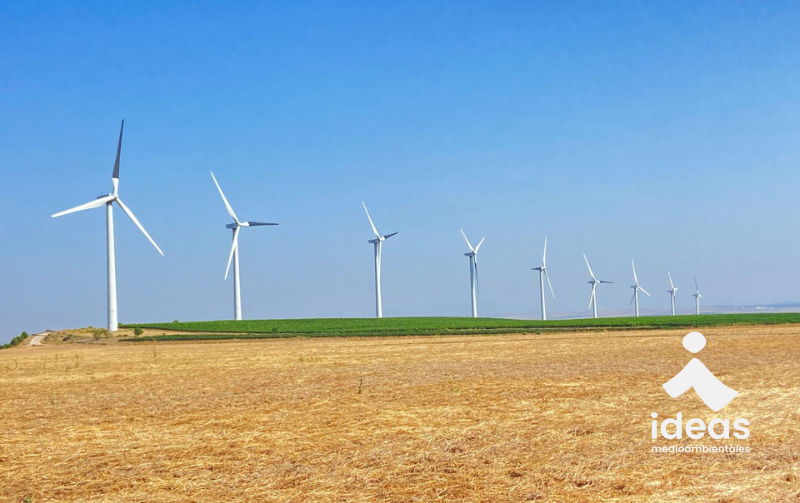
Technical constraints of blade painting
Painting one or all of a wind turbine's blades involves several technical issues:
- Paints in colors other than the standard ones (gray or white) heat up more, placing greater thermal stress on the blade and shortening its service life (greater material degradation due to more intense thermal cycles). Black-painted blades can reach temperatures 17ºC higher than standard colors (Pockett, 2010). This can also lead to accelerated aging of the paint (more frequent coating inspections and repainting, or loss of protective properties such as anti-corrosion or hydrophobicity).
- More pronounced thermal expansion, which can affect structural balance, especially if not all blades are painted and there are thermal differences between them. This can cause vibrations or asymmetrical loads.
- Reduction of operational downtime due to bird collisions or automatic shutdown mechanisms. This also avoids the frequency of corrective maintenance by preventing birds from damaging sensors, paint, or other components upon impact.
- Aerodynamic effects (rotor performance), especially in very hot or sunny conditions.
- Need to recalibrate sensors that depend on heat or temperature.
Legal constraints
There are also legal constraints derived from an Environmental Impact Statement (EIS).
- Painting one or all of a wind turbine's blades is usually motivated by a condition in an EIS. Otherwise, painting them may require notification to the environmental authority, which may in some cases require an additional environmental assessment or lead to penalties or restoration requirements.
- Painting can alter the visual integration of the wind turbine into the environment (especially in areas of high landscape value). Therefore, urban planning regulations may restrict or condition the visible colors of infrastructure or require the preparation of a landscape integration study.
- The colors used must comply with aeronautical easement regulations.
- In Spain, compliance with the Guide for Marking and Lighting of Turbines and Wind Farms (AESA, 2017) is mandatory. This guide sets the technical specifications for wind turbines (those over 100 meters tall or located within areas affected by aeronautical easements are considered obstacles to air traffic). It stipulates that, to ensure the safety and regularity of aircraft operations, blades must be painted white or off-white (Royal Decree 862/2009 of May 14, Technical Standards for the Design and Operation of Public-Use Aerodromes, Appendix 1; Figure A1-2 Surface Aeronautical Light Colors). The developer of a new facility may determine, with proper justification, the suitability of alternative marking due to the site's environment, such as in the case of wind farms located in areas with snow for much of the year. If an alternative marking is chosen, it must guarantee an equivalent level of safety and be approved by AESA. As a general rule, marking colors shall be traffic white (RAL 9016) and traffic orange (RAL 2009). Alternatively, traffic red (RAL 3020) is permitted in combination with off-white (RAL 9002), agate grey (RAL 7038), or light grey (RAL 7035). The use of appropriate daytime luminous colors is also permitted.
- The ICAO (International Civil Aviation Organization) recommends that the blades, the nacelle (nacelle), and the upper 2/3 of the wind turbine tower be painted white, unless an aeronautical study indicates another color to improve safety. Many EU member states have national air safety regulations that implement ICAO recommendations for marking visible obstacles. For example, Germany has administrative regulations (“General Administrative Regulation on the Labelling of Aeronautical Obstacles”) which specify that wind turbines must be marked with conspicuous colors, typically white, and include requirements for lighting and day/night marking.
- In Spain, compliance with the Guide for Marking and Lighting of Turbines and Wind Farms (AESA, 2017) is mandatory. This guide sets the technical specifications for wind turbines (those over 100 meters tall or located within areas affected by aeronautical easements are considered obstacles to air traffic). It stipulates that, to ensure the safety and regularity of aircraft operations, blades must be painted white or off-white (Royal Decree 862/2009 of May 14, Technical Standards for the Design and Operation of Public-Use Aerodromes, Appendix 1; Figure A1-2 Surface Aeronautical Light Colors). The developer of a new facility may determine, with proper justification, the suitability of alternative marking due to the site's environment, such as in the case of wind farms located in areas with snow for much of the year. If an alternative marking is chosen, it must guarantee an equivalent level of safety and be approved by AESA. As a general rule, marking colors shall be traffic white (RAL 9016) and traffic orange (RAL 2009). Alternatively, traffic red (RAL 3020) is permitted in combination with off-white (RAL 9002), agate grey (RAL 7038), or light grey (RAL 7035). The use of appropriate daytime luminous colors is also permitted.

Environmental constraints
It must be emphasized that there are not enough studies to corroborate the effectiveness of this measure regarding birdlife. Currently, data is available from studies conducted in Smøla (Norway), where 4 wind turbines were painted in a very specific environment (snowy areas), which considerably increases the visibility of black blades, and in Eemshaven (Netherlands), where 7 small wind turbines were painted; therefore, there are no specific studies on large-scale wind turbines. These studies conclude that painting one of the three blades can reduce bird collisions by up to 70%.
Another advantage is that it is a non-invasive mitigation measure (compared to acoustic deterrents, automatic shutdowns, etc.).
Conversely, two negative aspects should be noted:
- Maintenance (frequent repainting) can increase the project's carbon footprint.
- Increased visual impact by breaking the homogeneity of the structure.
Possible design alternatives
The Spanish Wind Energy Association proposes alternative solutions to this problem, aiming to create a contrast between the wind turbine and its immediate surroundings. This increases visibility for birds without significantly increasing the visual impact on the landscape or for observers.
To achieve this, it is proposed to paint the tip of the turbine blade or to paint two to three stripes, as shown below:

The AEE proposes the use of two possible colors: traffic red (RAL 3020) and traffic orange (RAL 2009), choosing one or the other based on the ambient temperature of the project's location.

These colors are currently included in the catalogs of various wind turbine blade manufacturers, meaning they can be produced without the need for additional certifications. These colors comply with the requirements of the State Aviation Safety Agency (AESA) regarding the marking of aviation obstacles.
Conclusions
Painting wind turbine blades is a promising mitigation measure for reducing bird mortality from collisions. Although preliminary studies suggest reductions of up to 70%, the available scientific evidence remains limited and focused on very specific contexts. Therefore, further research across different environments, species, and turbine types is necessary to validate its effectiveness on a larger scale.
From a technical standpoint, this measure presents challenges related to increased thermal stress, accelerated aging of coatings, and potential structural imbalances in the case of partial painting. It also entails additional maintenance costs and a visual impact that may affect the landscape integration of wind farms.
In terms of legal and regulatory frameworks, painting must comply with aviation safety requirements and environmental impact statements, which in some cases limits the use of colors other than white or gray. Nevertheless, there are industry-proposed alternatives—such as painting tips or stripes with approved colors—that could offer a balance between visibility for birds and regulatory compliance.
In conclusion, painting blades is a complementary, non-invasive, and potentially effective measure for reducing collisions, but it should not be considered a sole or definitive solution. Its implementation should be evaluated on a case-by-case basis, integrated into a broader set of preventive, corrective, and, as a last resort, compensatory strategies that ensure renewable energy production while allowing for the conservation of biodiversity.
References
o AEE (2023), Implications of painting blades black. Prevention measures for birds. Spanish Wind Energy Association.
o AESA (2017), Guide for Marking and Lighting of Wind Turbines and Wind Farms.
o Jones,M. P., Pierce, K. E., & Ward, D. (2007). Avian vision:A review of form and function with special consideration to birds ofprey. Journal of Exotic Pet Medicine, 16(2), 69–87. https://doi.org/10.1053/j.jepm.2007.03.012
o May, R., Nygård, T., Falkdalen, U., Åström, J., Hamre, Ø., & Stokke, B. G. (2020). Paint it black: Efficacy of increased wind turbine rotor blade visibility to reduce avian fatalities. Ecology and Evolution, 10(16), 8927– 8935. https://doi.org/10.1002/ece3.6592
o Pockett, J. (2010), A Review of Heat-Reflective Paints.
.avif)
.jpeg)