.avif)

Operation, environmental impacts, and the regulatory framework of Royal Decree 997/2025 in the promotion of sustainable energy storage in Spain.
The battery energy storage systems (BESS) are becoming one of the most important tools for decarbonizing the electrical system. Their ability to store renewable energy and release it when demand requires makes them an essential ally for the stability of electrical grids.
What is a BESS?
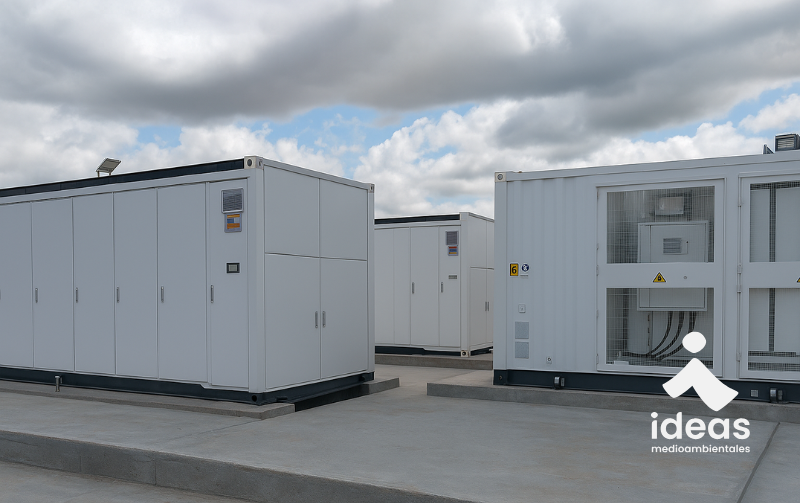
A BESS is a facility capable of storing electrical energy in batteries and releasing it later for use. It consists of batteries, conversion systems (inverters), transformers, control and protection systems, and intelligent management software.
There are two main types of configurations:
- Stand-alone BESS: independent installations connected directly to the power grid. Their function is to balance supply and demand, stabilize frequency and voltage, and provide services such as black start or ramp control.
- Hybrid BESS: these combine storage with renewable generation plants (solar or wind). In this way, they compensate for the natural intermittency of these sources, providing synthetic inertia and more stable grid integration.
Both types allow for better utilization of green energy, reduction of demand peaks, and strengthening of supply security.
Main environmental impacts of BESS systems
Battery Energy Storage Systems (BESS) represent a key technology for advancing toward a low-carbon energy model. However, like any technological infrastructure, their implementation entails a series of both positive and negative environmental impacts, which must be properly assessed and managed throughout their life cycle. Overall, the environmental balance of these types of projects is highly favorable for sustainability.
Positive impacts:
- Greater integration of renewable energy and reduction of CO₂ emissions.
- Reduction of consumption peaks and improvement in transmission and distribution efficiency.
- Lower land use: high energy density compared to other technologies.
- Possibility of landscape integration through vegetation screens and location near existing electrical infrastructure.
Negative impacts (controllable):
- Extraction of raw materials (lithium, cobalt, nickel) with potential effects on soil and water.
- End-of-life management of batteries and the need for efficient recycling.
- Noise and temporary disturbances during construction or decommissioning phases.
Environmental impacts by project phase
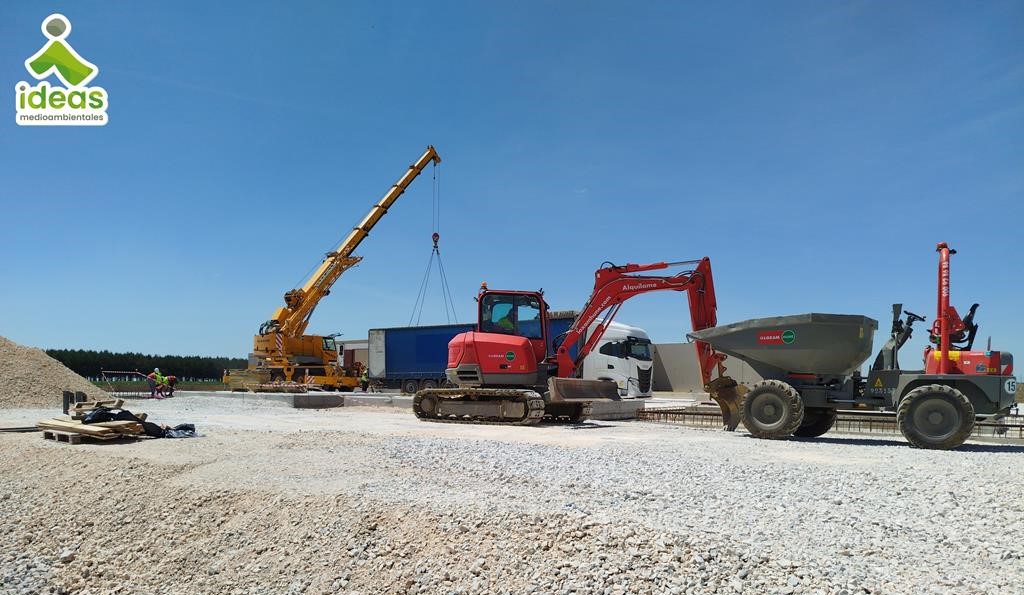
The implementation of BESS projects, whether stand-alone or hybrid with renewable plants, comprises three fundamental stages: construction, operation, and decommissioning, each with specific environmental impacts that must be managed through preventive and corrective measures.
During the execution of the works, temporary impacts may be generated related to:
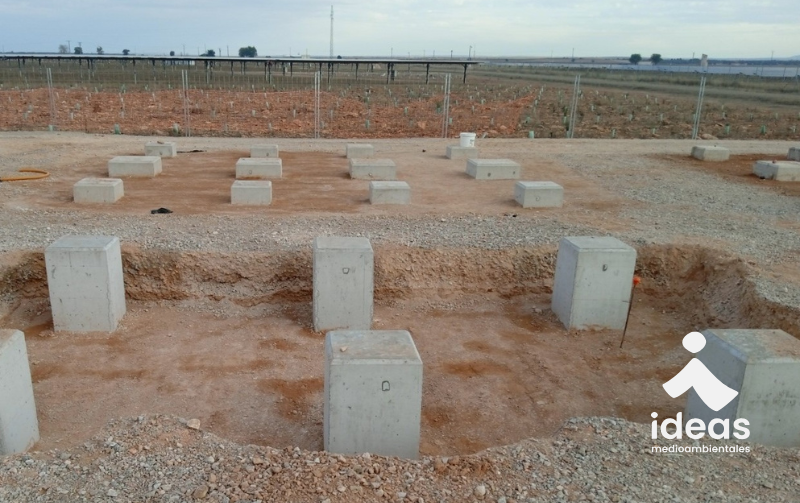
- Earthworks, material stockpiling, and foundations.
- Localized alterations to soil, geology, and hydrology due to excavations.
- Increased ambient noise and machinery traffic.
- Indirect impacts on nearby fauna and habitats.
- Minimal and reversible loss of agricultural land or temporary changes in land use.
Finally, in the decommissioning phase, the impacts are considered positive, as the land is recovered and construction elements and auxiliary facilities are removed. Actions include electromechanical dismantling, controlled removal of materials and waste, and environmental restoration work that returns the surroundings to their original conditions, ensuring complete reversibility of the affected space.
However, environmental assessments and corrective measures (recycling, environmental restoration, sustainable sources) ensure a reduced and controlled impact.
Royal Decree 997/2025: New regulations boosting energy storage in Spain
The recent Royal Decree 997/2025 approved by the Council of Ministers on November 5, 2025, which establishes urgent measures to strengthen the electrical system (BOE, November 6, 2025), reinforces the resilience and stability of the national power grid, with a clear focus on promoting energy storage and the electrification of the economy.
The general aspects of Royal Decree 997/2025 can be summarized as follows:
- It aims to streamline administrative procedures and strengthen the resilience of the electrical system, especially following the incident on April 28, 2025.
- It focuses on boosting energy storage, in line with the goals of the PNIEC 2023-2030, which projects reaching 22.5 GW of storage capacity by 2030.
- It integrates changes into several regulatory frameworks: Law 21/2013 on Environmental Assessment, Royal Decree 1955/2000, and Royal Decree 1183/2020, among others.
Regarding regulatory changes, RD 997/2025 incorporates, in its second final provision, the amendment of Annex II of Law 21/2013, of December 9, on Environmental Assessment, to exempt hybridized storage from simplified environmental assessment, provided that such storage is located within the environmentally assessed perimeter of the original energy project and provided that this original project has favorable environmental impact statement or, where applicable, a favorable environmental impact report.
However, as established in article 6.2.a of Royal Decree 997/2025, the developer must submit documentation justifying their exemption from the environmental assessment process, meaning they will need to prove that the proposed project does not violate the conditions of the Environmental Impact Statement for the energy project with which it is hybridized.
Furthermore, these energy storage projects must be accompanied by a series of complementary studies required by the competent authority, from which the new regulation does not exempt them, to demonstrate safety, legal compliance, and the responsible integration of these facilities into their surroundings, fostering social acceptance and the sustainable development of energy infrastructure. The most relevant include:
- Noise study, to analyze the noise emissions of the equipment and ensure compliance with the limits established by applicable regulations.
- Electromagnetic field study, in order to evaluate human exposure to the fields generated by electrical equipment and ensure their conformity with legal limit values.
- Preliminary soil or waste management report, aimed at identifying potential impacts on the land and establishing appropriate measures for the prevention, control, and treatment of waste generated during the various phases of the project.
- Fire risk study, with the objective of identifying, evaluating, and controlling the fire and explosion risks associated with the battery energy storage system, ensuring the safety of people, facilities, and the environment, as well as compliance with current industrial and environmental safety regulations.
In addition, these new facilities must be integrated into the environmental monitoring and surveillance efforts of the projects with which they are hybridized.
What happens if the BESS project is located outside the boundaries of the approved project or is a stand-alone BESS system?
In that case, a simplified environmental assessment procedure must be carried out, as established in Annex II of Law 21/2013, of December 9, on environmental assessment, specifically, section n) of Group 4, Energy Industry.
Given all of the above, BESS systems represent not only a technological advancement but also an environmental and social commitment. Their proper implementation, supported by rigorous impact, noise, and electromagnetic studies, ensures cleaner, more stable, and more responsible energy development.
Are you thinking about implementing a Battery Energy Storage System (BESS)?
At Ideas Medioambientales we help you manage the entire environmental and administrative process, from impact assessment to comprehensive project permitting.
Our technical team, specializing in renewable energy and storage , guarantees agile, secure, and compliant management, optimizing every phase of development to ensure the legal, technical, and environmental feasibility of your installation.
Contact us and take the next step toward a successful and sustainable energy storage project.
Bibliography
Spain. (2025). Royal Decree 997/2025, of November 5, approving urgent measures to strengthen the electrical system. Official State Gazette, 267, November 6, 2025.
Spain. (2013). Law 21/2013, of December 9, on Environmental Assessment. Official State Gazette, no. 296, of December 11, 2013, pp. 98151–98227. https://www.boe.es/eli/es/l/2013/12/09/21

.avif)
.jpeg)